Salt: The Mineral We Can’t Live Without


 Pandora
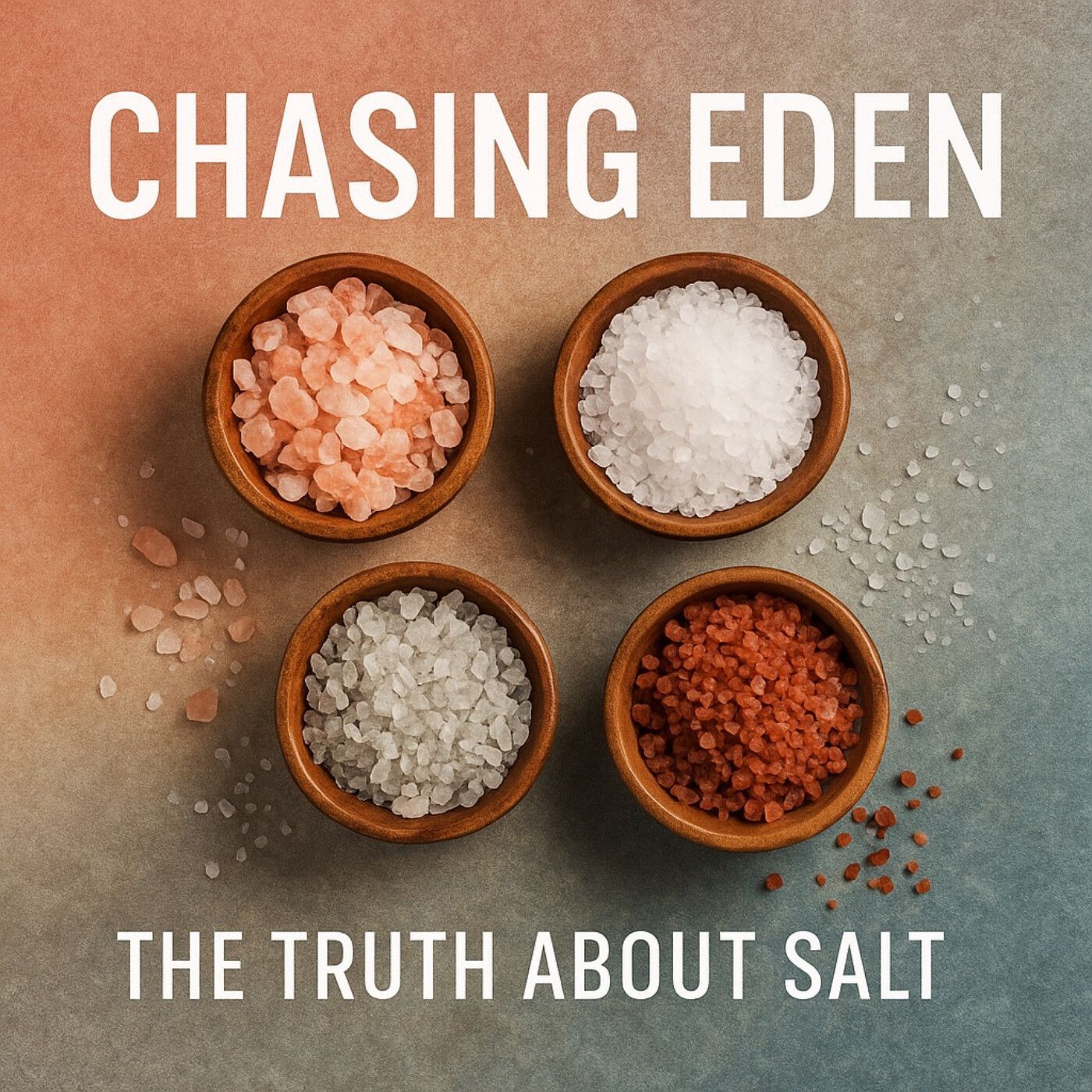
For decades, salt has been portrayed as a dietary villain—blamed for high blood pressure, heart disease, and more. But is salt really the problem, or have we been misled? In this episode of Chasing Eden: Natural Health God’s Way, Caroline Thompson unpacks the history of salt’s demonization, where it began, and why modern research is restoring this essential mineral to its rightful place in a healthy diet.From the pink crystals of the Himalayas to the gray richness of Celtic sea salt, the fiery Red Hawaiian salt, and the highly recommended Baja Gold, you’ll discover the fascinating varieties of salt around the world and their unique health benefits. Featuring insights from health leaders like Dr. Eric Berg, Dave Asprey, Gary Brecka, Dr. Ardis, and Dr. Barbara O’Neill, we’ll explore how the right kinds of salt can support hydration, energy, brain health, digestion, and longevity.We’ll also tackle modern concerns like microplastics in sea salt, and why choosing pure, mineral-rich salts matters more than ever. If you’ve ever wondered whether salt is friend or foe, this episode will give you a fresh perspective and practical steps for adding life-giving minerals back into your diet.See Privacy Policy at https://art19.com/privacy and California Privacy Notice at https://art19.com/privacy#do-not-sell-my-info.
Hosted by Simplecast, an AdsWizz company. See pcm.adswizz.com for information about our collection and use of personal data for advertising.
0:06 Welcome back to Chasing Eden, Natural Health, God's Way. I'm your host, Carolyn Thompson, and today we're diving into a mineral that has shaped civilizations, been traded like gold, preserved food for centuries, and is absolutely essential to human health. Yet it has been demonized and misunderstood for decades. I'm talking about salt. Now, if you grew up hearing the standard medical advice cut down on salt, avoid sodium. Sodium it causes high blood pressure, you may have a little alarm bell ringing in your head right now. They hang on with me, because that's exactly what we're going to unpack today. How salt got demonized, why that narrative isn't the full truth, and what leading voices in natural health are now saying about the vital role of salt in our bodies. Will cover the fascinating history of salt around the world, the many different types of salt Himalayan, Celtic, Baja, Red, Hawaiian, and more, the very real health benefits of salt, the deception and fear campaign that made salt the villain of our diets, and what health leaders like doctor Bergh, Dave Asbury, Gary Brecca, doctor artists and doctor Barbara O'Neil say about consuming salt, and yes, the new concerns about micro plastics
1:38 in commercial sea salts and how to choose wisely. So grab your favorite mineral rich salt shaker and let's get into it. So let's talk about salt through the ages, the global history of it. Salt has been called the white gold. The entire economies and empires were built on salt roots. Roman soldiers were once paid in salt. The word salary actually comes from solarium, their salt allowance. From the ancient Egyptians using salt to preserve mummies, to the Celt's harvesting Celtic sea salt to Himalayan pink salt formed from ancient sea beds. Salt has always been recognized as both life sustaining and medicinal. Salt wasn't feared, it was revered, and only in the last sixty to seventy years has it been cast as the bad god. So where did this anti salt narrative come from? Well, in the mid twentieth century, as heart disease rates climbed, researchers began looking for dietary culprits. A man named Ansel Keys and you may know him from the infamous seven Cuntry Trees study linked saturated fat and cholesterol with heart disease. And around that same time, some studies suggested there was a correlation
3:08 between high sodium and high blood pressure. Suddenly, salt became a scapegoat, and by the nineteen seventies and eighties, the low salt diet was being pushed by the American Heart Association, the USDA, and mainstream doctors. But here's the kicker. Those early studies were flawed. They often looked at processed table salt stripped of minerals, combined with diets full of refined carbs and processed foods. They ignored the fact that other factors like sugar, seed, oils, and environmental toxins also plate a role. Natural health leaders like doctor Eric Berg have repeatedly emphasized that salt doesn't cause high blood pressure. The real culprit is insulin resistance and sugar salt actually helps maintain fluid balance and cellular function. It's sugar that diamages the arteries unquote. So he's saying that sugar is the problem in not salt, and yet for decades millions of people were told to fear the very mineral that keeps our hearts pumping and our nerves firing. So let's clear the air. Salt is not optional for human life. It's essential.
4:32 Sodium chloride and trace minerals and natural salts play critical roles in your electrolyte balance, which keeps nerves firing and muscles contracting, including your heartbeat, your hydration because without salt, water can't get into your cells effectively, and also your adrenal function. Salt supports cortisol balance and energy levels, as well as stomach acid production. Chloride is needed to make hydrochloric acid for digestion. Now, you may have done some research on digestion if you've had issues with your stomach, or if you've had IBS or a bal syndrome, and what you might have discovered is that there is actually supplements for hydrochloric acid out there on the market that a lot of people will go purchase and then take when they're having a heavy meal to help them to build up their stomach acid and break down the food in their stomach. What the problem is is there's a couple different problems. For one, if you don't have enough salt in your system, you're not going to make enough hydrochloric acid. And for another, if you're drinking too much fluid with your meals, you're going to water down the stomach acid as well. And Barbara O'Neil actually does have a video where she talks about how she doesn't even drink water while she's eating that when herner has been go to a restaurant, they just go ahead and let the server ser of water because that's what they automatically do.
6:05 But they never even take one sip about water during the meal because they want to make sure that their stomach acid stays. You know, that it's not watered down and it can actually break down their food. So salt also plays a role in our brain health. Sodium helps to transmit electrical signals. I also want to stop here and point out that you may have also seen that in science. If you've ever taken advanced science classes, you may have seen them do maybe in your lab, an experiment where they will actually show you how salt can the electrical charge in salt can light a light bulb.
6:50 And you can look that up on YouTube or somewhere on social media and you can actually see that experiment if you're interested. Now. Gary Breca, he's a human biologists and I really enjoy his videos on Instagram. He's loaded with information. He's very passionate, and he's really really good at communicating information to you when you're listening. So I would highly recommend following him on social media. He's just a really great guy. But this is what he says. Quote, every single cell in your body is like a battery, and salt is what charges it. Without sodium, potassium, and magnesium, your cells can't regenerate the energy of life. Unquote. Dave Aspery, you may know who he is. He's the founder of Bulletproof and also the biohacking movement has also criticized the low salt narrative, and he says this quote one of the simplest performance hacks is just adding mineral rich salt back into your water. Your mitochondria depend on sodium and potassium gradients. If you cut salt, you cut energy unquote.
8:00 So keep in mind, a lot of us like to use filters to filter our water, and that's a good thing because we do want to filter out the stuff that's in our tap water. And you might have a brit of picture in your fridge, and they're really having a field day right now with people who use brit pictures on social media because they're saying those really don't work that well and you're not getting out everything, and you really need to look into something a little more intense and of course more expensive, because they're trying to sell you they're water filters, and I'm not saying these aren't great water filters. I'm just saying that the Brita filter is probably not the best filter to be using to be filtering your water. Now that being said, you have now taken everything out of that water. And in nature, water has structure. So when you go drink spring water, you're actually drinking water that has been flowing over minerals and collecting minerals from different types of rocks. And by the time you get that spring water in your glass, you've got a water that's got a lot of minerals in it, and so it's a healthy water and it has structure. So when we drink water that's been filtered, oftentimes, if you're not familiar with the word adsorbent, but that's what water is. It's an adsorbent the water will go into our system and it will actually start pulling minerals out of our body because its tendency is to pull the minerals out of the rocks and stuff that it
9:32 runs over. So when it goes into your body, it starts pulling minerals out. So if you want to make sure that you're getting hydrated properly, you're going to want to try to switch to spring water or do what Dave says, and that is by adding mineral rich salt back into your water. And I do that myself. I will not drink filtered water without putting a pinch of salt into it and stirring it up first, because I know otherwise you're going to be run into the bathroom. To be honest, you're just going to pee it all out because you don't have enough minerals in the body or salt to help you to hydrate those cells, to fill those cells up. So that being said, Doctor Artists, who speaks often on hidden medical deception, has said this quote.
10:17 They told us to fear salt while pushing processed food and sugar. Salt was never the problem. It's the lack of nutrients and the toxins in our food supply unquote. Now there's a lot of salts around the world, too many to talk about, way too many. It's crazy how many salts there are. But not all salts are created equal. So let's explore some of the most popular and beneficial salts that we hear about around the world. I'm sure you've heard of Himalayan pink salt that is mine from ancient sea beds in Pakistan. I've also heard that there's some sea beds that we might not call sea beds.
11:00 But I've heard of Himalay and pink salt being mined in other places. I want to say, Utah has A has some something. They call it a type of red salt. Himalayan salt. Now, Himalayan and pink salt is rich in over eighty trace minerals. It's known for its pink color hue, and that's due to the iron oxide in it. It's popular in natural health circles for balancing pH and supporting hydration. I have a Himalayan pink salt in my cupboard and the next salt. I also have Celtic sea salt. It's harvested from tidal ponds off the coast of France. It's grayish in color due to its mineral rich clay. It has a moist texture and full spectrum spectrum of minerals, and it's recommended by many nature paths for adrenal support. Now, this third salt, Baja gold Sea salt, I just startart keeping in my cupboard a couple of months ago because I heard doctor Barbara O'Neill recommend it, because she believes it to be pretty pure compared to some of the other salts. She says this quote, Baja salt is harvested from the Sea of Cortes and contains the highest concentration of minerals with the lowest contamination. If you want a truly safe, nutrient rich salt, Baja salt is the gold standard unquote. Another salt which I've never used is red
12:32 Hawaiian salt. It's mixed with volcanic red clay, so it's rich in iron oxide and it's traditionally used in Hawaiian rituals and cooking. It's mineral dense and has a unique earthy flavor. This next salt, black Lava salt, I have had up until a few months ago. I actually ran out of it it's infused with activated charcoal, and it has strong detoxifying properties and it adds a dramatic finish to foods, which is kind of hilarious because the times that I've used the salt, it is so strong. You have to be really really careful using black lava salt, and you definitely don't want to put it like directly on your tongue. It's just super duper intense. I actually used to sprinkle black lava salt when I had it into my bone broth. When I would be boiling the chicken bones to make my bone broth, I would add this salt because I knew it would add a nice flavor to my bone broth. So that one's a nice one.
13:32 I wouldn't mind getting myself some more of that. There's also kosher salt, and that's named for its role in koshering meat. Larger crystals, less process than table salt. It lacks the mineral profile of Himalayan or Celtics, so it doesn't have a lot of minerals, but it has its benefits to We also know of table salt, which is refined salt. Now this is the bad guy. It's been stripped of its minerals bleached, refined, and it's often laced with anti caking agents or even microplastics. It's associated with the negative health effects that gave salt its bad reputation.
14:13 So table salt I haven't had for many, many years, and that's something I wouldn't purchase at all now. Doctor Berg he advocates mineral rich salts for electrolyte balance, especially on ketogenic diets. He warns that low salt diets can cause fatigue and muscle cramps. You may have already experienced that. I know I have. Salt helps our bodies to hold hydration, so make sure that you are incorporating some type of mineral rich salt into your daily life. Dave Asprey also recommends high mineral salts in water for energy and mitochondrial health. Gary Brecatt emphasizes the electrical balance electrolyte balance as foundational for longevity and cellular performance. Doctor Artists warns against processed table salt and highlights the deception of low salt guidelines, and doctor Barbara O'Neal strongly endorses the Baja Gold salt as the purest and safest choice today. One of today's biggest concerns is the discovery of microplastic particles in sea salt, and this is one of the reasons why I kind of panic bought some of that Baja salt after I watch Barbara O'Neill talk about it not having the contaminants in it as the other salts. Studies have found that many commercial sea salts, especially from polluted waters, contain microscopic plastic fragments from ocean waste. This raises a valid concern
15:44 are we trading minerals for microplastics? And this is why many health experts recommend sourcing our salt from ancient protected sea beds like Himalayan or carefully tested sources like Baja goal. These salts avoid the tamination found in modern ocean harvested salts. Now you will see there are people demonizing Himalayan salt as well, and then you have your other side saying, hey, it's actually not that contaminated. It's really one of those things where you just have to go gather your information and then make the best educated decision that you can.
16:24 I decided to switch to the Baja salt. I do use the flaky, the flaked Malden salt sea salt oftentimes in my cooking and different things. But you educate yourself and figure out what the best salt is for you to use in your diet. It's really really important that you incorporate these for your health. So how can you incorporate salt into your life? Well? In the morning, this is something I do. You can add a inch of mineral rich salt to your morning water to support hydration and adrenal function. This is called structured hydration or what Dave Asprey calls structured hydration. It's really important that you do this first thing in the morning. You've been fasting all night and most likely you're waking up dehydrated. So start your day with some minerals to get yourself the energy that you need. In your cooking. You can use Celtic, chimelaine or Baja gold salt in your daily meals for natural flavor and mineral content. Honestly, when I go to boil noodles, I put quite a bit of salt in that water, knowing that it's going to infuse into those noodles and make it into my body. There's really rarely anything that I don't find an excuse to put salt in.
17:45 I actually put salt in the flaky Malden salt in my coffee to help cut some of the bitterness off and to help myself get some more salt in my body. You can also give yourself an electrolyte boost with the salt. Especially on low carb diets, people sometimes can get some muscle cramps and stuff on those, So keep in mind that if you are dieting and you're trying to go low carb, you're definitely going to want to be paying attention to adding some salt into your diet. Now, another way you might not have thought of to add salt to your body is through a salt bath. I just took one of these the other day. And magnesium and minderal rich salts like epsom salt or Himalayan they support relaxation and detoxification. One of the great things about a magnesium bath is its ability to help you with muscle pain and inflammation, and it helps you to relax as well, and it's a great way to absorb the magnesium through the skin in a nice hot bath. Definitely drink water when you do that if you're going to be in a hot bath sweating and keep in mind that magnesium you can take orally, and I definitely recommend that it's something that everyone needs to be taking every single day.
19:13 I have a podcast on magnesium. You might go look that up. There's different types of magnesium and they have different purposes. But one great way to take in magnesium is through a bath. Avoid the table salt, so skip that refined white salt with its anti caking chemicals and zero nutrients. So Luckily, people are waking up and they're getting more and more educated about salt, So the narrative on salt is shifting and salt is no longer the enemy to a lot of people. It's actually essential for life and they're starting to realize this. So yes, processed table salt and ultra process salts and foods are harmful, butural mineral rich salts. They're part of God's design for the human body. So when we demonized salt, we actually stripped people of a life giving nutrient. Luckily, health voices across the spectrum, from biohackers to nature paths are calling us back to balance with our thoughts on salt and the way it's perceived. So it definitely deserves to be put in its rightful place, not as a villain in our lives, but as a place where it deserves to be a foundational mineral for health, energy, and longevity. And that brings us to the end of today's episode of Chasing Eden Natural Health God's Way. We've journeyed through the
20:45 history of salt, exposed the decades long deception that demonized it, highlighted the health benefits and the many types of salts available, and shared insights from leading health voices. The truth is simple. Without salt, there is no life. And when we choose wisely Himalayan, Celtic, Baja Gold, Red, Hawaiian, we're not just seasoning our food, We're nourishing our bodies. If you enjoy today's episode, please subscribe to the podcast and share it with a friend who might need to hear this message. For articles, resources and health guides moving forward, please visit us online at Chasingeden dot net. Until next time, stay nourished, stay curious, and keep chasing Eating